
The history of billiards stretches across more than five centuries. What began as an indoor adaptation of an outdoor stick-and-ball game gradually became a favourite of royal courts, gentlemen’s clubs, pubs, professional tournaments and private games rooms. The equipment changed just as dramatically, progressing from wooden beds and mace-like implements to precision slate, responsive cushions and finely crafted cues.
At Hamilton Billiards, that history still matters. Whether we are restoring an antique table or creating a bespoke new one, every project belongs to a tradition shaped by generations of players, inventors and craftspeople.
From Outdoor Games to Royal Tables
The precise birthplace of billiards remains disputed, with both France and England appearing in its early story. The game is generally understood to have developed from outdoor lawn games in which players moved balls using curved sticks. Raising the playing area onto a table allowed the pastime to continue indoors and gradually transformed it into something increasingly recognisable.
One of the earliest firm records comes from a 1470 inventory associated with Louis XI of France, which lists a billiard table and balls. Early tables did not yet resemble modern examples. They could include hoops, pins or other obstacles, retaining much of the character of the lawn games from which they evolved.
Those early royal tables eventually gave way to increasingly sophisticated pieces of furniture. Today, collectors can still explore Hamilton’s antique full-size billiard tables, whose timberwork, proportions and detailing reflect centuries of table-making development.
From the Mace to the Modern Cue
Early billiards was played with a mace, an implement with a broad curved head used to push the ball. When a ball rested close to the cushion, players sometimes turned the mace around and used its narrow tail. This practice helped give rise to the straight cue.
The cue changed billiards from a game of largely pushing balls into one based on controlled striking. A major advance followed in 1807, when the French player François Mingaud is credited with popularising adding leather to the cue tip. The improved grip made off-centre striking and controlled spin far more practical, opening the door to a much richer range of shots.
Modern players may take this degree of control for granted, but it grew from generations of experimentation. Hamilton’s collection of antique billiards accessories offers a glimpse of how cue racks, scoring equipment and games-room furnishings developed alongside the tables themselves.
How Slate and Rubber Transformed the Table
For centuries, billiard-table beds were made from timber. Wood could shrink, swell or warp as conditions changed, making consistently accurate play difficult. During the nineteenth century, the British table maker John Thurston helped reshape the industry by introducing slate beds during the 1820s.
Slate provided a flatter and more stable foundation. Thurston then introduced natural-rubber cushions during the 1830s and patented vulcanised-rubber cushions in 1845. These replaced older padded designs and provided a more dependable rebound in changing temperatures. Together, these developments established much of the essential structure of the modern billiard table.
Our guide to what to look for in a quality billiards table explains why the bed, frame, cushions and cloth must still work together. The same principles can be seen in Hamilton’s handmade snooker tables and handmade pool tables, where traditional cabinetmaking meets the accuracy expected by modern players.
One Game Becomes Many
As billiards spread, it developed into a family of related games. English billiards grew around a three-ball format, while several forms of pool became popular on smaller pocketed tables. Snooker emerged later and is commonly dated to 1875, when British Army officers in Jabalpur, India, began experimenting with additional coloured balls.
Readers interested in that particular branch can explore our article on the history of snooker before browsing Hamilton’s range of snooker tables.
Pool developed along its own paths, producing the British and American games represented throughout our pool-table range.
Bar billiards followed another route. The compact game became established in Britain during the early twentieth century and suited pubs where a full-size table would occupy too much space. Our article on the history and resurgence of bar billiards traces that journey, while Hamilton’s restored and newly manufactured bar billiards tables continue the tradition today.
The Billiard Room Becomes a Statement Interior
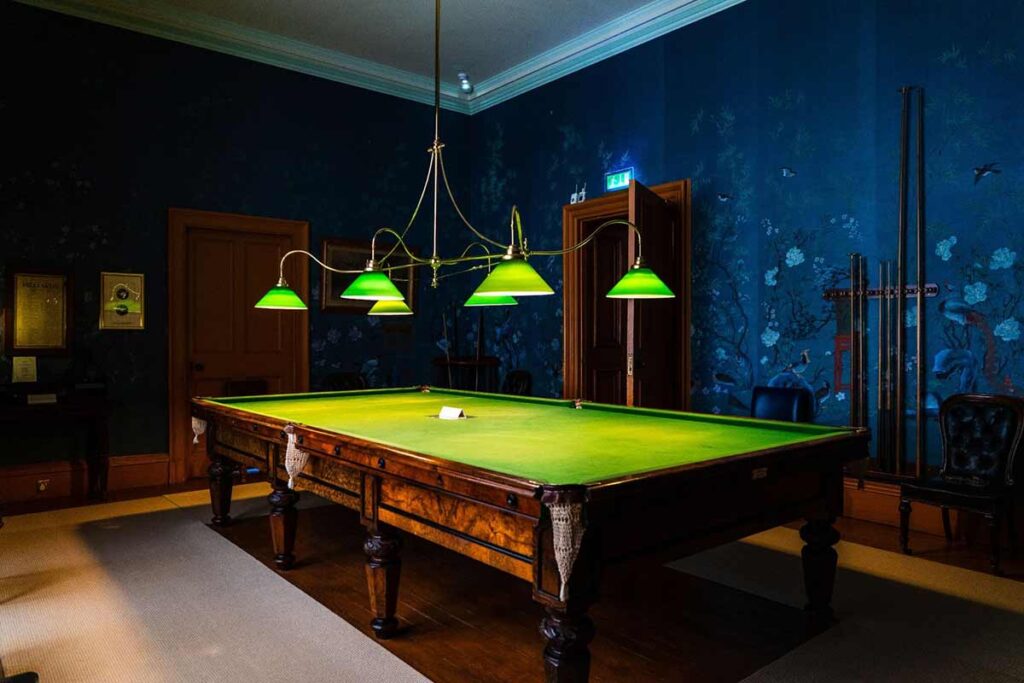
By the Victorian and Edwardian periods, a billiard table could be both sporting equipment and an important piece of furniture. Tables were constructed from mahogany, oak and other timbers, often featuring turned legs, carved details and decorative fittings. The surrounding room might include cue racks, marker boards, fitted seating and dedicated lighting.
Surviving tables from these periods carry the character of their makers and former owners. Hamilton’s antique snooker tables are carefully restored so their craftsmanship can be enjoyed without sacrificing playability.
Our billiard and snooker restoration service can include removal, assembly, baizing, repairs, polishing and re-rubbering, depending on the condition and history of the individual table.
Billiards in the Modern Home
Billiards no longer belongs only to palaces, clubs or dedicated country-house rooms. Modern homes call for tables that complement contemporary interiors and, in some cases, perform more than one job.
Hamilton’s pool dining tables can convert from an everyday dining surface into a playable pool table, making cue sports possible where a separate games room would be impractical.
For customers seeking something entirely individual, our custom pool-table gallery shows how size, timber, finish, cloth and detailing can be developed around a particular room. The appearance may be modern, but the central challenge remains unchanged: build a table that is accurate enough for the game and handsome enough to deserve its place in the home.
Continuing the Story at Hamilton Billiards
For more than four decades, Hamilton Billiards has worked with antique, restored and newly manufactured tables. Our craftsmen preserve historic pieces while creating new tables for homes, businesses, interior designers and collectors around the world.
Visit the Hamilton Billiards showroom to compare assembled antique and handmade tables, examine their construction and discuss what would suit your space. From royal courts to modern games rooms, billiards has endured because it continues to evolve without losing the character of the game.